Introduction to SolPol
Incoming solar radiation is considered unpolarized before it enters the Earth’s atmosphere.
Throughout its propagation in the atmosphere polarization changes, through the absorption and scattering interactions with various atmospheric components including aerosol particles, water droplets,ice crystals and molecules. The transmitted (direct) sunlight is always unpolarised, except when it propagates through oriented particles in the atmosphere.
Interpreting linear polarization measurements in the direct direction, i.e. measurements taken when the observer looks directly towards the illuminating object, can be challenging due to the overwhelming intensity of light and secondary sources of linear polarization in the observational line-of-sight.
Brief Overview
SolPol (Solar Polarimeter) is an experimental ground-based solar polarimeter used for direct sunlight polarization measurements. It operates both under laboratory and field conditions depending on the application at hand and provides near real-time observations of the complete Stokes vector, [I,Q,U,V].
The instrument was initially developed at the University of Hertfordshire (UH) and was used both in-lab and mounted on an astronomical telescope, so as to acquire both linear and circular polarization signatures.
It was, after that, kindly conferred to the National Observatory of Athens (NOA) within the framework of the D-TECT project and operated on-demand from the PANGEA (PANhellenic GEophysical observatory of Antikythera) station.
The instrument’s robust design allows for measurements under diverse environments, while its tracking capabilities opt for continuous monitoring of the sunlight polarization state.
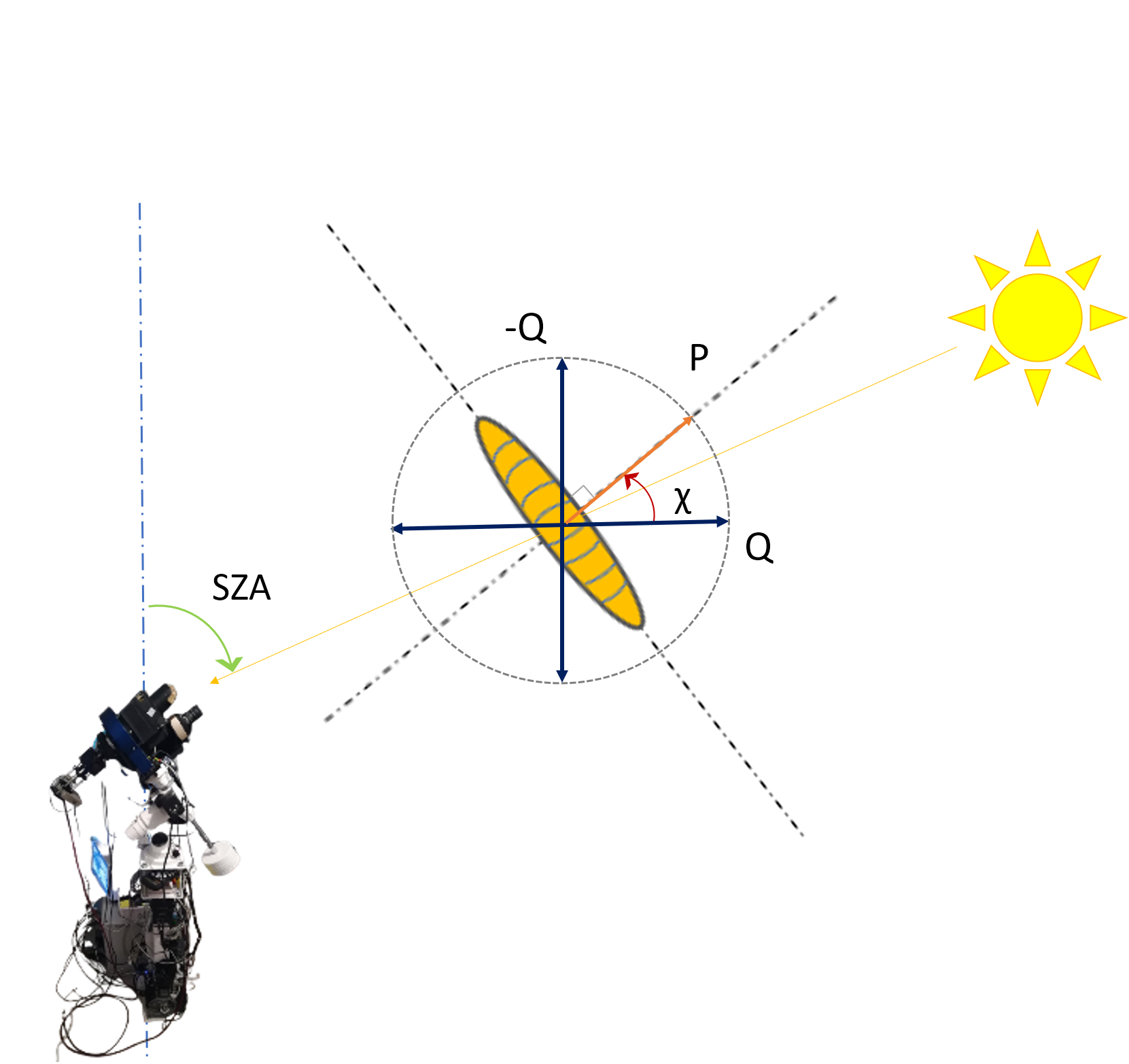
SolPol measures:
the Total Intensity (TI) of the incoming light, expressed by the I Stokes parameter
the Linear Polarization (LP), expressed by the Q and U Stokes parameters,
and
the Circular Polarization (CP), expressed by the V Stokes parameter,
from the solar disk and as light tarvels through the entire atmospheric columm.
Depending on its limiting field-of-view aperture and the choice of mounting element (to be continued).